How an Education Company Rescued a Dying Email Channel, and Went from 15% to 0.1% Bounce Rate in 15 Days
A 15% Bounce Rate Isn't a Content Problem. It's a Credibility Crisis.
When 95% of your emails never get opened, the instinct is to blame the subject line, the copy, or the offer. But in most cases, the real problem is invisible to the sender and it happens long before a human ever sees the message.
Moozoom, a USA and Germany-based education company serving schools with a subscriber-driven model, was experiencing exactly this kind of failure. Open rates had collapsed to 5%. Bounce rates sat at 15%. And emails that did send were landing in spam folders or disappearing entirely never reaching the educators and administrators who had opted in to receive them.
The problem was not their offer. It was not their audience. It was their infrastructure. Incomplete DNS authentication, no domain warmup, misconfigured email tooling, and zero sender reputation meant that every major mailbox provider Gmail, Outlook, Yahoo was treating Moozoom's emails as untrustworthy traffic and blocking them accordingly.
What followed was a 15-day deliverability rebuild that took Moozoom from a 5% open rate to 35%, reduced bounces from 15% to 0.1%, and transformed email from a burned channel into a predictable growth engine. This is how it happened.
About Moozoom
Moozoom operates in the education sector, serving schools across the United States and Germany with a subscriber-based business model. Their audience educators, administrators, and school decision-makers relies on timely communication to stay informed about products, services, and resources that support their institutions.
Email is not an optional channel for Mozoom. It is the primary way they maintain ongoing relationships with their subscriber base, announce new offerings, and drive engagement with their platform. When email performance deteriorates, it does not just affect metrics it severs the connection between the company and the schools that depend on them.
By the time Moozoom reached out, their email channel was not just underperforming. It was actively burning their domain reputation with every send a situation that, left unaddressed, would have rendered email completely unusable within weeks.
When Infrastructure Failure Masquerades as a Messaging Problem
Mozoom's team knew their email performance was broken. What they did not know and could not diagnose without technical expertise was why. The symptoms were visible. The root causes were not.
Five Critical Infrastructure Failures, All Happening Simultaneously
Failure 1: Open rates had collapsed to 5% meaning 19 out of every 20 emails sent were either never delivered, filtered to spam, or ignored entirely.
Failure 2: Bounce rates sat at 15% far above the 2% threshold that triggers reputation damage, signaling serious list hygiene and authentication issues.
Failure 3: Emails were landing in spam folders or failing to deliver at all not because of content triggers, but because mailbox providers did not trust the sender.
Failure 4: Email tooling was misconfigured domain authentication, tracking settings, and sending configurations were incomplete or misaligned, compounding every other issue.
Failure 5: DNS authentication was incomplete SPF, DKIM, and DMARC records were either missing, incorrectly configured, or not propagated, leaving mailbox providers with no way to verify Moozoom as a legitimate sender.
Failure 6: No domain warmup had been performed Moozoom was sending at full volume on a cold domain with no sender history, triggering automatic spam filtering.
Failure 7: No whitelisting or engagement strategy existed there was no structured process for building positive engagement signals that would improve inbox placement over time.
The Turning Point Insight
Moozoom's messaging was not the problem. Their subscriber base had not disengaged. The issue was entirely technical: without proper SPF, DKIM, and DMARC authentication, without a domain warmup process, and with misconfigured email tooling, mailbox providers treated every email Moozoom sent as low-trust traffic. The content never had a chance to perform because it was being filtered out before a human could read it.
This is the pattern that makes infrastructure-driven deliverability failures so dangerous: the damage accumulates silently, the symptoms look like audience fatigue or bad content, and by the time the team realizes the issue is technical, weeks or months of sender reputation have already been destroyed.
SECTION 3: THE SOLUTION
The 15-Day Deliverability Rebuild, Fix the Foundation, Then Scale
Mozoom's situation required a full infrastructure rebuild, not optimization. The solution followed a strict sequence: repair the technical foundation first, warm the domain gradually, then and only then resume campaign sends. Skipping any step would have meant repeating the same failures.
Deliverability Infrastructure Repair, Establish Sender Credibility
SPF record configured and validated ensuring that mailbox providers could verify which servers were authorized to send mail on Mozoom's behalf.
DKIM implementation cryptographic email authentication deployed to prove that emails were genuinely from Mozoom and had not been tampered with in transit.
DMARC setup policy framework established to tell mailbox providers how to handle emails that failed SPF or DKIM checks, protecting both Mozoom and recipients from spoofing.
DNS propagation verification ensured that all authentication records were live, correctly formatted, and visible to Gmail, Outlook, Yahoo, and other major providers.
Sending domain alignment corrected primary brand domain isolated from outreach sending domains to protect brand reputation in case of future deliverability issues.
Domain whitelisting initiated reputation-building process started with engagement-focused sends to build positive trust signals with mailbox providers.
15-Day Controlled Domain Warmup, Rebuild Trust Gradually
Gradual send volume increase starting with small batches and ramping up incrementally over 15 days to avoid triggering spam filters with sudden volume spikes.
Engagement signal building early sends targeted highly engaged subscribers to generate positive open and click signals that improve sender reputation.
Inbox placement optimization daily monitoring of spam folder placement, bounce patterns, and provider-specific filtering to catch and correct issues in real time.
Sender reputation stabilization allowing mailbox providers time to observe consistent, legitimate sending behavior before scaling to full campaign volumes.
No campaign sends during warmup zero promotional or outreach emails sent until the domain had established stable trust with all major providers.
Email Tooling Optimization Align Configuration with Best Practices
Domain authentication reconfigured within email platform ensured that SPF, DKIM, and DMARC records were correctly integrated with Mozoom's sending tool.
Sending configurations fixed corrected IP assignments, volume throttling, and bounce handling to prevent technical errors from damaging reputation.
Tracking optimization email open and click tracking settings adjusted to balance deliverability with analytics visibility.
DNS-to-platform alignment verified ensured that authentication records, sending domains, and email tool settings were all referencing the same infrastructure correctly.
Post-warmup campaign rollout only after full technical stability and consistent inbox placement did promotional sends resume.
The timeline was non-negotiable. Infrastructure first. Warmup second. Campaign execution third. Attempting to skip warmup or send at volume before authentication was stable would have burned the domain beyond recovery.
From 5% to 35% in 15 Days A Complete Channel Recovery
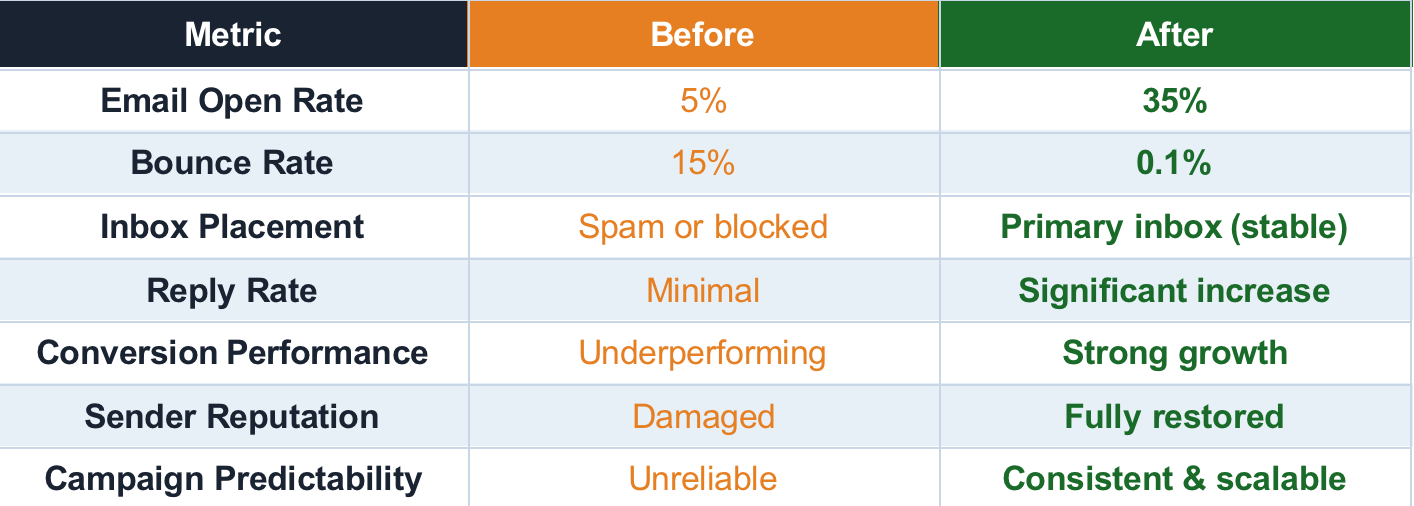
Before vs. After : The Full Transformation
 Metric
What a 700% Open Rate Increase Actually Means
Moving from 5% to 35% open rate is not an optimization , it is a channel recovery. It means that for every 100 emails Moozoom sends, 30 more subscribers are now reading them. At scale, this translates to thousands of additional engagements per campaign, directly impacting lead generation, subscriber retention, and revenue.
But the more important number is the bounce rate reduction: from 15% to 0.1%. A 15% bounce rate actively damages sender reputation with every send. Reducing it to near-zero means Moozoom is no longer compounding their own deliverability problems with every campaign.
The 35% open rate is particularly notable given that Moozoom sends through a cold email platform subject to stricter filtering and deliverability scrutiny than traditional ESPs. Achieving this level of performance on such a platform proves that the infrastructure rebuild was comprehensive and sustainable.
Business Impact, Beyond the Metrics
The recovery delivered operational transformation, not just better numbers. Mozoom went from actively burning their domain and losing inbox trust to running a stable, high-performing email engine that generates predictable results. The email channel shifted from a source of frustration to a reliable growth driver.
Lead generation improved. Subscriber engagement surged. Sales conversations became more frequent and higher quality. And perhaps most importantly, Mozoom regained confidence in their ability to reach their audience something that had been completely absent when open rates sat at 5%.
“Cold email success starts with infrastructure not just copy. By fixing deliverability at the DNS level, warming domains correctly, and properly configuring our platform, we transformed Mozoom's outreach channel into a consistent growth driver.”
— Recovery Summary
3 Lessons Every Email Sender Needs to Understand
Moozoom's situation is not unique. Infrastructure-driven deliverability failures affect businesses across every industry from education to SaaS to e-commerce. Here is what this case study teaches:
Lesson 1: A 5% Open Rate Means Your Infrastructure Is Broken Not Your Message
When open rates fall below 10%, the problem is almost never content. It is authentication, sender reputation, or technical configuration. Mailbox providers are filtering your emails before humans can read them. No amount of subject line testing or copy optimization will fix a DNS authentication failure or a cold domain sending at volume. Fix the foundation first then optimize the message.
Lesson 2: Domain Warmup Is Not Optional It Is the Difference Between Inbox and Spam
Sending at full volume on a cold domain with no sender history triggers automatic spam filtering. Mozoom's 15-day warmup was not a precaution it was a requirement. Gradual volume increases, engagement signal building, and inbox placement monitoring are the only way to build trust with mailbox providers. Skip warmup, and you burn your domain. There is no shortcut.
Lesson 3: Bounce Rates Above 2% Are Actively Destroying Your Sender Reputation
A 15% bounce rate does not just mean wasted sends. It signals to mailbox providers that you have poor list hygiene, outdated data, or are sending unsolicited mail all of which damage your reputation with every campaign. Reducing bounces to near-zero is not a nice-to-have. It is a survival requirement for any email program operating at scale.
Is Your Email Channel Heading Toward the Same Crisis?
Open rates declining without explanation. Bounce rates creeping above 5%. Emails landing in spam more frequently. These are early warning signs of the same infrastructure failures that nearly destroyed Mozoom's email channel. The good news: if caught early, the rebuild takes 15 days not months.
Get a Free Email Deliverability Audit
We will review your SPF, DKIM, and DMARC configuration, analyze your sender reputation across major providers, and identify exactly what is hurting your inbox placement. No sales pitch just diagnosis.