How a High-Volume Fashion Email Outreach Went from Spam Folder to 60% Open Rate

Most email deliverability problems don't announce themselves. They creep in quietly, a dip in open rates here, a few more bounces there, until one day you realize that your most loyal subscribers haven't heard from you in weeks, not because they stopped caring, but because your emails never made it past the spam filter.
That's exactly where R13 Denim found themselves. A New York-based fashion label with a hard-earned subscriber list of engaged customers was sending 40,000 emails a day to people who actively wanted to hear from them. Open rates had cratered to 17%. Spam placement was rampant. And their domain reputation, the invisible trust score that determines whether your email reaches an inbox or a junk folder, was in freefall.
The turnaround took a methodical, three-phase approach. The result? A 253% improvement in open rates from 17% to 60% was achieved without a single gimmick, without a subject line overhaul, and without adding a single new subscriber to the list.
This is the story of how R13's email channel went from a liability to one of the most reliable drivers of customer engagement in their business.
About R13 Denim
R13 is a New York-based fashion brand known for its distinctive denim, ready-to-wear collections, and accessories that embody the rebellious spirit of downtown culture. From signature harness boots to boundary-pushing takes on classic denim silhouettes, R13 has cultivated a loyal following of fashion-forward customers who value quality craftsmanship with an edge.
Email has always been central to how R13 connects with its community. Their subscriber list isn't cold contacts scraped from a database; it's real customers and brand enthusiasts who opted in specifically to hear about new drops, exclusive offers, and seasonal collections. At 40,000 daily sends, email was supposed to be their highest-volume, most reliable touchpoint.
Supposed to be, but it wasn't.
When the Channel Breaks, and You Can't See Why
R13 arrived at a critical inflection point. Their email program, once a dependable revenue channel, had become unpredictable and increasingly unreliable. The symptoms were hard to ignore, but the root causes were invisible to the internal team.
The Visible Warning Signs
Warning Sign 1: Open rates are stagnant at 17%, roughly a third of the industry average for engaged subscriber lists.
Warning Sign 2: Widespread spam folder routing across Gmail, Outlook, and Apple Mail, meaning loyal subscribers weren't seeing messages at all.
Warning Sign 3: Bounce rates are climbing steadily as invalid addresses and disconnected users accumulate in the list, damaging sender reputation with every failed send.
Warning Sign 4: Domain reputation in visible decline; trust signals from major mailbox providers were deteriorating month over month.
Warning Sign 5: Blacklisting risk looms. Historical sending patterns had created exposure that could effectively kill the channel overnight.
The Turning Point Insight
R13 had a quality audience. Their list wasn't the problem; it was the technical infrastructure underneath it. At 40,000 emails per day, even a small deliverability issue compounds at extraordinary speed. What looked like a content or engagement problem was actually a foundational infrastructure failure. No subject line optimization in the world would fix it.
“We were sending 40,000 emails a day to people who wanted to hear from us, but we had no idea if our messages were actually reaching them. The data told us something was seriously wrong, but we didn't have clear visibility into which issues were affecting deliverability the most or how to prioritize fixing them.”
— R13 Denim Team
The Three-Phase Deliverability Recovery System
Jumping straight into campaign execution would have been a mistake. The foundation was broken, and a clever content strategy cannot compensate for infrastructure failure. The solution followed a deliberate, sequenced playbook: fix the foundation first, build safeguards second, optimize and scale.
Foundation Repair: Fix the Infrastructure Before Touching the Campaigns
Full technical audit: domain reputation analysis, DNS configuration review, SPF/DKIM/DMARC alignment checks.
Blacklist identification and strategic removal, plus addressing the root sending behaviors that caused each listing.
Controlled warmup procedures to rebuild mailbox provider trust gradually, not forcing volume through damaged infrastructure.
Detailed bounce analysis: hard bounces were removed immediately, soft bounces were monitored, and patterns were analyzed for systematic list hygiene failures.
Daily monitoring dashboards established for spam placement, bounce rates, and technical errors; real-time visibility, not retrospective guesswork.
Safeguard Layer: Make the Recovery Sustainable
Daily monitoring routines track spam placement across all major providers: Gmail, Outlook, Apple Mail, and Yahoo.
Early warning systems for bounce pattern anomalies, flagging disconnected users before they accumulate into reputation damage.
Ongoing domain reputation tracking gives R13 visibility into their sender standing that they had never had before.
Deliverability transformed from a mysterious black box into a measurable, manageable metric with clear accountability.
Campaign Execution: Scale on a Solid Foundation
Full campaign setup and routing, aligned entirely with inbox placement best practices from day one.
Dynamic volume control send rates are adjusted in real time based on live reputation signals, not fixed schedules.
Content and sending pattern review to eliminate spam triggers before campaigns are launched.
Performance tracking is tied directly to inbox placement results, not just surface-level vanity metrics.
The sequence matters. Infrastructure first. Safeguards second. then Optimize. This order is non-negotiable, and it's why the results proved sustainable rather than temporary.
From Crisis Management to Consistent Performance
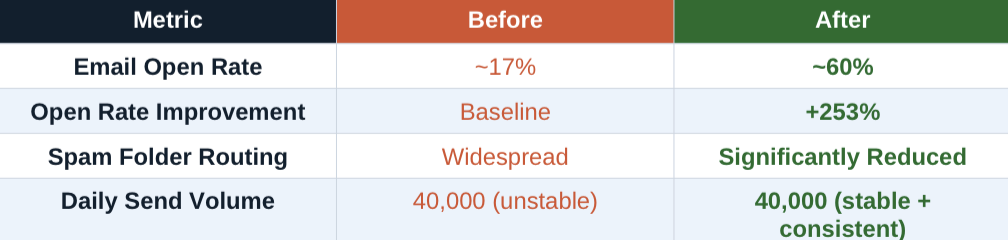
Before vs. After: At a Glance

What the Numbers Actually Mean
A jump from 17% to 60% open rate isn't an optimization win; it's a channel recovery. At 40,000 daily sends, that difference translates to roughly 17,200 additional subscribers receiving and engaging with every single campaign. That's not a metric. That's the audience.
More importantly, the improvement didn't fade. This wasn't a spike caused by a re-engagement campaign or a purged list. The monitoring infrastructure built in Phase 2 meant the new baseline held and continues to hold.
“We went from constantly putting out fires to actually being able to plan and execute our email strategy. Having confidence that our messages will reach our subscribers has been transformational for how we think about email as a channel.”
— R13 Denim Team
3 Lessons Every High-Volume Email Sender Needs to Know
R13's situation isn't unusual. High-volume email programs degrade silently, and the warning signs are easy to misread. Here's what this case study teaches us:
Lesson 1: Fix Deliverability Infrastructure Before Touching Copy
80% of cold email and subscriber email failures are deliverability problems disguised as messaging problems. Before you rewrite a subject line or A/B test a CTA, run a domain health audit. Check your SPF, DKIM, and DMARC. Pull your blacklist exposure. If your infrastructure is broken, no amount of copywriting will save you.
Lesson 2: Volume Makes Every Problem Worse, Faster
At 40,000 daily sends, a 5% spam placement rate means 2,000 emails hitting junk folders every single day. Problems that would take months to notice at low volume can destroy a program in weeks at scale. The higher your volume, the more urgently you need real-time monitoring, not monthly reporting.
Lesson 3: Prevention Infrastructure Is Not Optional: It Is the Product
R13's biggest long-term gain wasn't the open rate improvement; it was the monitoring systems that prevent the problem from returning. Sustainable deliverability is a process, not a project. The goal is to never need another crisis recovery.
Is Your Email Program One Bad Send Away from This Problem?
Most email deliverability issues are invisible until they're critical. If your open rates have been flat or declining, if you're sending at volume without real-time monitoring, or if you've never audited your domain reputation, the R13 scenario is closer than you think.