From Damaged Domain Reputation to 60–70% Open Rates
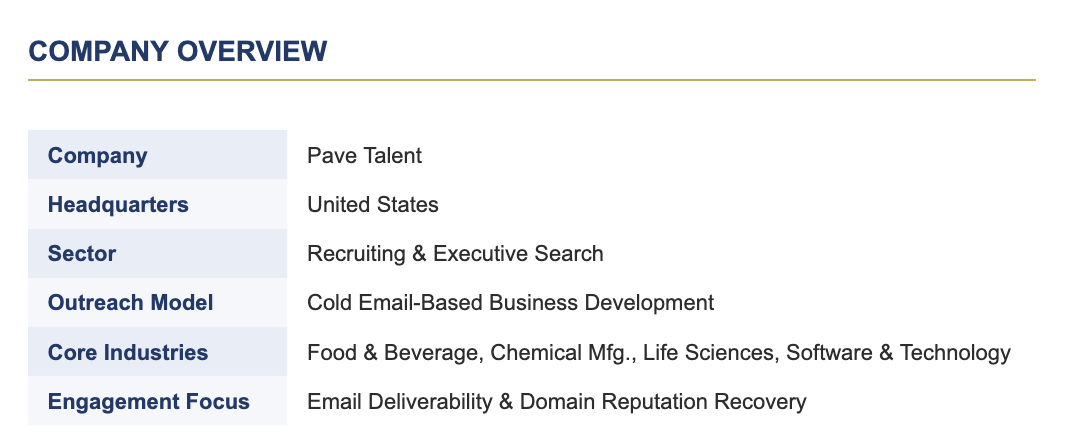
Pave Talent is a U.S.-based recruiting firm connecting high-growth companies with exceptional direct-hire talent. Their specialisms span food and beverage manufacturing, chemical manufacturing, life sciences, software and technology, and adjacent sectors, a deliberately focused practice that allows their team to develop genuine market depth rather than spreading thin across every vertical.
THE CHALLENGE
When Pave Talent came to us, they were experiencing a compounding problem common to growing outbound teams: their cold email operation had degraded over time, and performance had quietly deteriorated to the point where outreach was no longer generating the results the business needed.
The core issue was domain reputation. Through a combination of sending practices that had not been properly managed — likely including sending too fast, insufficient warmup, and poor list hygiene, Pave Talent's sending domains had accumulated negative signals with major email providers. The result was a vicious cycle: low reputation led to poor inbox placement, which led to low open rates, which made it impossible to generate replies or book meetings at any meaningful rate.
1. Deliverability Breakdown
The most visible symptom was that emails were consistently failing to reach the primary inbox. Without reliable inbox placement, every other element of Pave Talent's outreach, their messaging, their targeting, their offers — was rendered irrelevant. You cannot convert on an email that nobody reads.
Emails routing to spam folders rather than primary inboxes
Sending domains flagged by major providers due to poor reputation signals
No systematic monitoring of deliverability health across domains
Inconsistent authentication setup contributing to domain distrust
2. Open Rates at Crisis Levels
As a direct consequence of the deliverability failures, Pave Talent's open rates had collapsed. For a recruiting firm whose business depends on timely, responsive conversations with both clients and candidates, low open rates are not just a vanity metric problem, they represent real pipeline and real revenue that simply is not materialising.
Open rates well below industry benchmarks for recruiting outreach
No reliable baseline from which to measure improvement
Inability to distinguish between messaging problems and deliverability problems
Team effort going into campaigns that were functionally invisible
3. Damaged Domain Reputation
Underlying both of the above issues was a degraded domain reputation, the root cause that had to be addressed before anything else could improve. Domain reputation is built over time through consistent, low-complaint, properly authenticated sending behaviour. Once damaged, it cannot be repaired overnight. It requires a structured, patient warmup process and a commitment to clean sending practices going forward.
Sending domain reputation scored poorly with major inbox providers
History of high-volume or poorly managed sending had left negative signals
No warmup strategy had ever been implemented on affected domains
Risk of domain blacklisting if sending continued without intervention
OUR STRATEGY
Our approach with Pave Talent centred on two core interventions: an aggressive domain warmup programme and a carefully planned send volume strategy. Unlike cases where broken technical authentication is the primary issue, Pave Talent's problem was fundamentally one of reputation, and reputation recovery requires a different kind of discipline.

Phase 1: Deliverability Audit & Diagnosis
Before making any changes, we conducted a thorough audit of Pave Talent's entire email infrastructure. This meant reviewing every sending domain, checking reputation scores across major inbox providers, auditing DNS and authentication records, examining historical sending patterns, and analysing bounce and complaint rates.
Audited all active and historical sending domains for reputation status
Checked domain and IP listings against major blacklists and spam databases
Reviewed SPF, DKIM, and DMARC configuration for gaps or misalignments
Analysed historical send data to identify sending patterns that had contributed to reputation damage
Assessed list hygiene, identifying hard bounce rates, spam trap exposure, and unengaged segments
The audit gave us a precise picture of which domains were recoverable and which needed to be replaced, and it established a clear baseline from which to measure improvement throughout the engagement.
Phase 2 : Aggressive Domain Warmup Programme
Warming a domain is the process of gradually rebuilding its sending reputation by starting with small volumes of highly engaged recipients and incrementally increasing send volume over time demonstrating to inbox providers that the domain sends wanted, legitimate mail.
For Pave Talent, we designed an accelerated warmup programme that was more aggressive than a standard warmup schedule reflecting the urgency of their situation while still being controlled enough to avoid triggering spam filters during the recovery period.
Identified the cleanest, most engaged segments of Pave Talent's contact database to use as warmup recipients
Designed a day-by-day sending schedule starting at minimal volume and scaling upward in measured increments
Prioritised sending to contacts most likely to open, click, or reply positive engagement signals that accelerate reputation recovery
Monitored domain reputation scores daily, adjusting the ramp schedule in response to real-time feedback from inbox providers
Ran parallel warmup across multiple domains to ensure sending capacity recovered as quickly as possible
Implemented list cleaning protocols to remove invalid addresses, spam traps, and chronically unengaged contacts before each warmup send
Phase 3 : Send Volume Planning & Ongoing Governance
One of the core reasons Pave Talent's reputation had degraded in the first place was a lack of structured send volume management. Without a deliberate plan governing how many emails were sent per domain per day and under what conditions volume could increase the team had inadvertently sent signals to inbox providers that raised red flags.
We addressed this by building a send volume framework that would govern Pave Talent's outreach on an ongoing basis, not just during the recovery period.
Defined per-domain and per-mailbox daily send limits calibrated to their current reputation scores
Built a volume escalation model with clear criteria for when and how sending limits could be safely increased
Set up monitoring alerts to flag anomalies sudden spikes, bounce rate increases, or complaint upticks before they could cause further damage
Trained the Pave Talent team on the logic behind the volume framework so they could maintain discipline independently
Established a regular review cadence to assess reputation health and adjust sending strategy in response to performance data
RESULTS & BUSINESS IMPACT
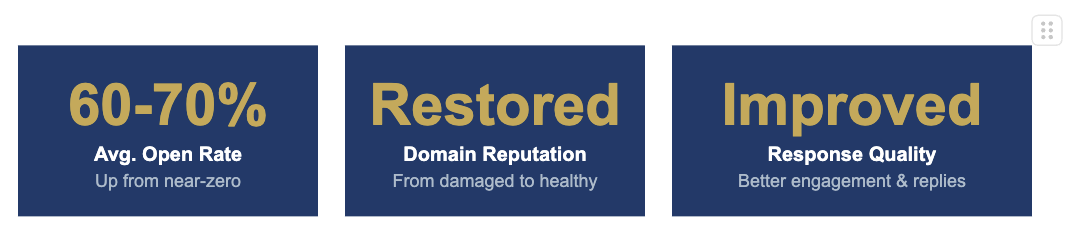
The results of the engagement validated the approach. Within the warmup period, Pave Talent's open rates climbed steadily from critically low levels to a consistent 60–70% average a figure that substantially outperforms industry benchmarks for recruiting outreach, which typically range between 25–40% for well-run campaigns.
Open Rate Recovery
Achieving 60–70% average open rates in the recruiting sector is a strong outcome by any measure. It reflects not just restored deliverability but the quality of Pave Talent's targeting and messaging both of which had been masked entirely when emails were not reaching inboxes. Once the deliverability floor was rebuilt, the genuine quality of their outreach became visible in the numbers.
These rates also provide a meaningful baseline for ongoing optimisation. With reliable delivery now established, Pave Talent can test subject lines, messaging angles, and send timing with confidence that variations in open rate reflect actual prospect behaviour not deliverability noise.
Improved Response Quality
Beyond open rates, Pave Talent reported a noticeable improvement in the quality of responses they were receiving. This is a natural downstream effect of better deliverability: when the right people are actually seeing your emails, the conversations that result tend to be more substantive. For a recruiting firm, where the goal is to start genuine dialogue with hiring managers and candidates, this improvement in response quality has direct commercial value.
Before vs. After Comparison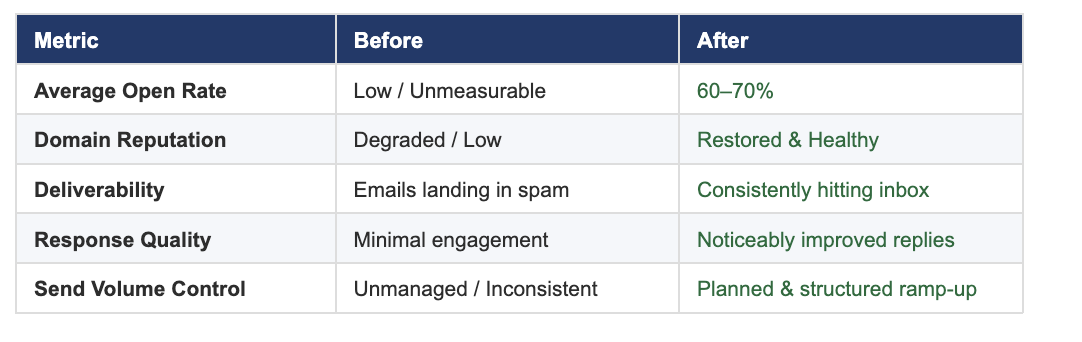
CONCLUSION
Pave Talent's engagement is a clear example of what happens when outreach infrastructure is allowed to degrade without active management and equally, what becomes possible when it is properly restored. The firm had strong fundamentals: deep sector expertise, a compelling service model, and a proven track record across a wide range of clients. None of that was visible to the market because their emails were not getting through.
The underlying cause was not a failure of strategy or messaging. It was a failure of infrastructure governance specifically, the absence of a warmup protocol and a structured send volume framework. These are not glamorous problems, but they are make-or-break for any outbound operation.
What the engagement demonstrated is that domain reputation, once understood and actively managed, is a recoverable asset. With the right warmup strategy and disciplined volume governance, Pave Talent was able to rebuild their sending reputation without replacing their domains wholesale — a faster and less disruptive outcome than many firms in a similar situation achieve.
The 60–70% open rates they now sustain are not just a recovery metric. They represent a genuine competitive advantage. In a market where many recruiting firms are fighting for attention in crowded inboxes, consistently landing in the primary inbox and earning opens at that rate means Pave Talent's outreach is working at a level most competitors cannot match.
Key Takeaways
Domain reputation is a manageable asset it degrades without care, but recovers with a structured, patient approach
Aggressive warmup, when designed correctly, can accelerate reputation recovery without triggering further penalties
Send volume planning is not a one-time setup it requires ongoing governance and a clear escalation framework
Low open rates are often a deliverability symptom, not a messaging problem diagnosing the root cause is essential before making creative changes
Restored deliverability unlocks the full value of existing targeting, copy, and market positioning that was previously invisible
Pave Talent now has both the infrastructure and the operational discipline to sustain and build on these results. Their domain reputation is healthy, their send volumes are governed by a clear framework, and their team understands the principles behind both meaning this is not a temporary fix but a durable capability.
The pipeline is clean. The emails are landing. And the conversations are happening.
Confidential Case Study • Results may vary based on industry, list quality, and campaign configuration