Cold Email Template Fatigue: Signs & Fixes
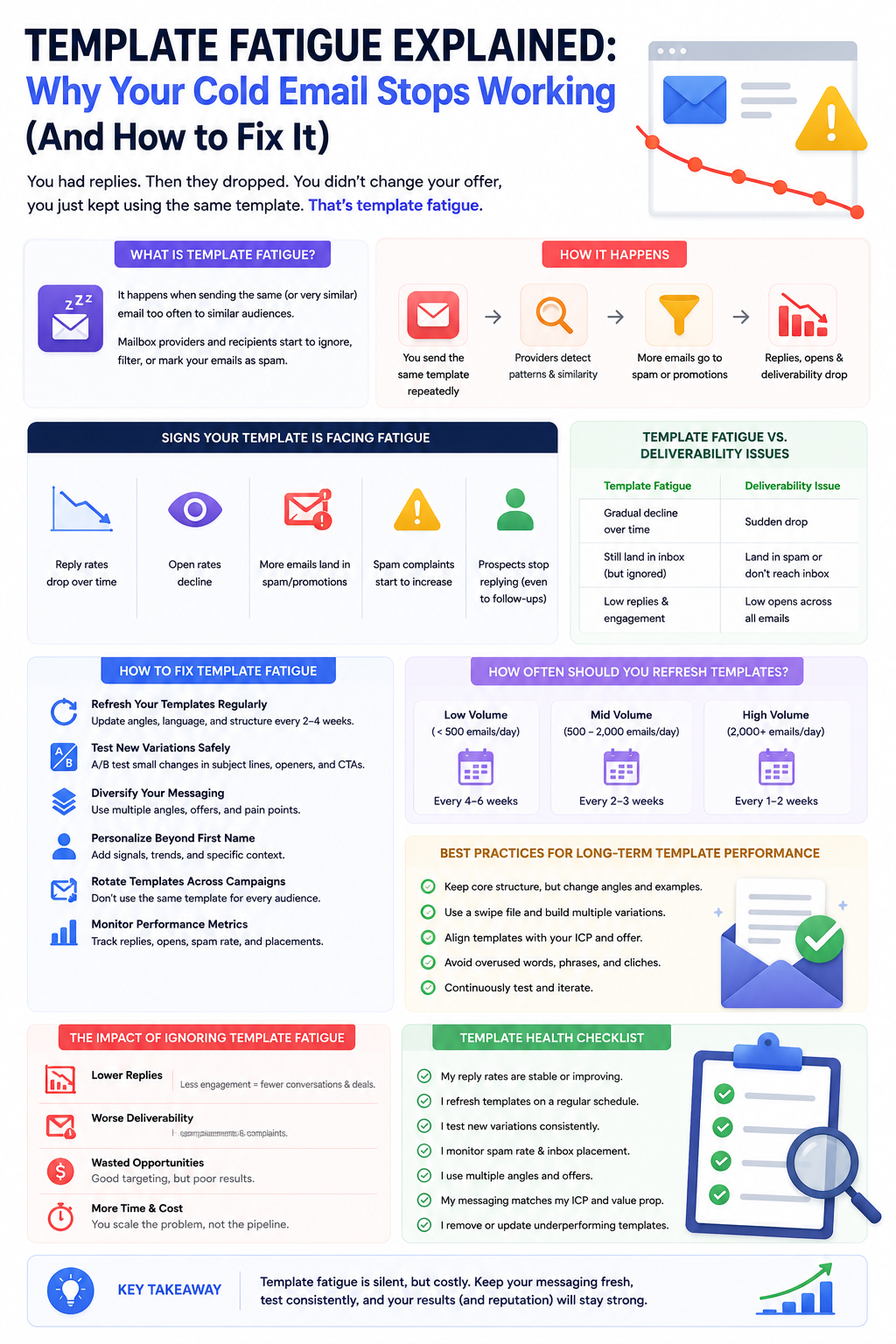
Template Fatigue: Why Cold Emails Stop Working (Fix It)
Your best-performing cold email doesn't stay that way forever. Reply rates slip, positive responses dry up, and the sequence that was booking meetings three months ago suddenly feels like shouting into a void. The culprit is usually template fatigue — and most SDRs don't catch it until the damage is done.
What Template Fatigue Actually Is (It's Not Just a Bad Email)
Template fatigue happens when identical messaging gets sent at scale, repeatedly, until it becomes predictable — to recipients and to mailbox providers alike. It's not a problem with using templates. Templates are efficient and necessary. The problem is running the same template for too long, across too many contacts, without meaningful variation.
The damage shows up gradually, which is what makes it so easy to misdiagnose. Reply rates don't fall off a cliff overnight. They slide a few percentage points per campaign, and most SDRs blame deliverability, list quality, or seasonality before they question the copy. By the time the template looks like the obvious culprit, you've already burned through a significant chunk of your ICP.
What's happening underneath is pattern recognition — both human and algorithmic. Recipients who receive enough cold email develop a radar for templated outreach. The moment they see a familiar structure, the reading stops. Mailbox providers do something similar: high-volume identical sends generate consistent signals that can erode inbox placement over time, compounding the engagement drop that was already underway.
Four Warning Signs Your Template Has Run Its Course
The earlier you catch these, the less remediation you need.
- Reply rate drops across two or more consecutive campaigns while your list quality, domain reputation, and authentication haven't changed. One bad campaign is noise. Two in a row is a signal.
- Positive reply rate falls even if total reply volume holds steady. You're still getting responses, but fewer of them express real interest. The template is generating reactions, not conversations.
- Open rates slide despite healthy sender reputation. If your domain is in good standing and authentication is passing, a declining open rate points to subject line fatigue — which usually precedes body copy fatigue.
- Spam complaints tick upward. Recipients who recognize templated outreach and find it irrelevant are more likely to hit "Report Spam" than unsubscribe. Spam complaint rates above 0.3% warrant immediate investigation, and template quality is one of the first things to check.
None of these signals is definitive on its own. Two or more appearing together in the same time window is your cue to act.
Why the Same Opening Line Stops Landing After a Few Hundred Sends
Phrases like "I noticed your company…" or "Quick question" appear in thousands of outbound sequences simultaneously. At any given moment, your prospect's inbox probably contains three to five emails that open with a nearly identical construction. The trust signal you were aiming for — "this person did their research" — gets inverted into "this is another batch email."
The problem intensifies when AI-generated personalization enters the mix. AI tools can produce first lines at scale, but without careful review and editing, they tend to land on vague compliments: "I love what your team is building" or "I came across your company and was really impressed." These lines sound personalized but communicate nothing specific. Recipients clock the pattern immediately, and it accelerates fatigue without adding the relevance that actually drives replies.
Predictable CTAs compound the issue. "Worth a conversation?" and "Open to a quick chat?" have become so common in cold outreach that recipients read past them without processing the question. The CTA that was differentiated eighteen months ago is now invisible. [unverified] There are no published benchmarks on the exact number of sends before a given phrase reaches saturation at a specific ICP, but the practical answer is: sooner than most teams expect.
The underlying dynamic is trust erosion before the value proposition lands. If your opening line reads as a template, your prospect has already mentally categorized the email before they reach the sentence where you explain why you're relevant to them.
Refresh the Opening: Three Swaps That Rebuild Relevance Fast
You don't need to rewrite the entire email. The opening is where pattern recognition fires, so that's where to focus first.
Swap generic openers for company-specific observations. A recent hiring surge in a particular department, a product launch you found in their changelog, a funding round from last quarter — these observations are specific enough that they can't be mass-produced. One sentence grounded in something real about the company does more than three sentences of generic flattery.
Lead with the recipient's likely problem instead of your research. Instead of proving you looked them up, acknowledge the challenge their situation creates: "Scaling outbound across multiple reps usually surfaces X issue" speaks to their reality without requiring you to have found a specific trigger event. This works especially well when you're targeting a segment where the problem is consistent but the trigger events are hard to find at scale.
Rotate between three opening styles across your active sequences:
- Context-based — a specific, verifiable observation about their business
- Problem-focused — an industry or role-level challenge stated plainly
- Curiosity-based — a question or framing that creates a reason to keep reading
Running all three in parallel gives you variation without requiring a full template rebuild. One strong, specific observation consistently outperforms three vague compliments — the specificity is the signal that earns attention.
Rotate Subject Lines Before Reply Rates Tell You To
Subject line fatigue hits before body copy fatigue in most campaigns. Recipients see your sender name and subject line in the same glance — recognition happens before the email is opened. If your subject line pattern looks identical to the last two emails they ignored, open rates drop regardless of what's inside.
Test at least three subject line styles and run them in rotation:
| Style | Example |
|---|---|
| Question-based | "Outbound infrastructure question" |
| Context-based | "Saw your Series B — congrats" |
| Direct statement | "Two ideas for your SDR team" |
Avoid ALL CAPS, excessive exclamation marks, and promotional language in subject lines. Beyond the spam risk these create, they're immediate pattern-match triggers for "marketing email" — exactly the categorization you're trying to avoid. Spam-adjacent formatting layers fatigue on top of deliverability risk, which is a combination that's hard to recover from quickly.
For most teams, reviewing subject line performance every four to eight weeks is the right cadence — closer to four weeks if you're sending at high volume, closer to eight if you're running tighter, more targeted campaigns.
Build a Template Rotation System So You're Never Running on One Version
The teams that avoid template fatigue aren't necessarily writing better emails — they're running more of them in parallel. Maintaining two to three active template variants per ICP, rotating them across campaigns rather than defaulting to the current winner, prevents any single version from accumulating too many sends before it's refreshed.
High-volume senders should review template performance every two to four weeks. Lower-volume teams can stretch that window to eight weeks without significant risk. The review doesn't need to be elaborate — pull reply rate and positive reply rate by template, look for a consistent downward trend, and treat that trend as the trigger to rotate in a new variant.
When you do test new copy, change one variable at a time: subject line, opening paragraph, or CTA — not all three simultaneously. [unverified] CRM and sequencing tools that flag template fatigue automatically based on engagement trends would simplify this significantly, but most teams still rely on manual review of campaign-level metrics. Testing multiple variables at once makes it impossible to know what moved the needle, which means you carry forward the same uncertainty into the next test.
Retiring an underperforming template is a data decision, not a creative judgment call. When positive reply rate drops consistently across two or more campaigns using the same template, that's your trigger. Keep underperforming templates archived — occasionally a template that fatigued against one ICP performs well when reintroduced to a different audience segment months later.
Next Steps
Use this checklist to audit your current templates before the next campaign goes out:
- Check reply rate and positive reply rate trends across your last three campaigns by template
- Confirm spam complaint rate is below 0.3% for each active sequence
- Identify any opening line or subject line that's been running unchanged for more than six weeks at meaningful volume
- Build at least two alternate versions of your highest-volume template — one context-based opener, one problem-focused opener
- Set a calendar reminder to review template performance every four weeks (high volume) or every eight weeks (lower volume)
- A/B test your next refresh by changing one variable at a time and running both versions against a comparable audience segment
XemailCampaign's built-in warmup and reputation monitoring runs continuously in the background — so when you refresh your templates and re-engage your sequences, you're working with clean performance data rather than guessing whether a dip is copy or deliverability.