Cold Email Reply Rate Benchmarks for B2B SaaS 2026
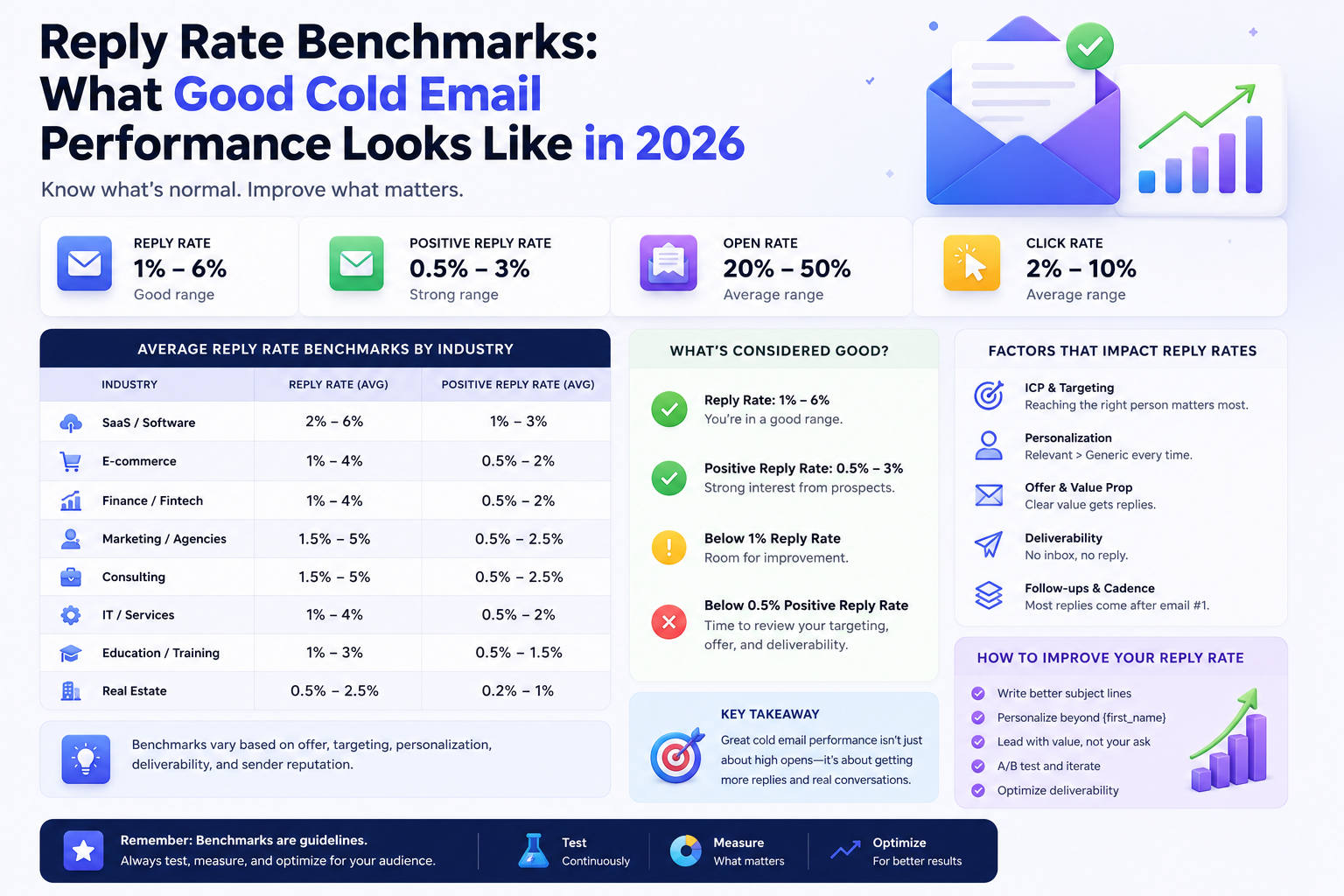
Cold Email Reply Rate Benchmarks for B2B SaaS in 2026
If your reply rate has flatlined and you're not sure whether to blame the copy, the list, or the moon, you need a benchmark to orient yourself. Here's what good, average, and poor cold email performance actually looks like in 2026—and what's most likely holding you back.
Reply Rate vs. Open Rate: Which Metric Actually Matters
Open rate feels like a progress metric, but it's increasingly unreliable. Apple Mail Privacy Protection, email security scanners, and auto-prefetching tools can all register an "open" without a human ever reading your message. That doesn't mean you ignore opens entirely—a sudden drop is still worth investigating—but you shouldn't be optimizing for them.
Reply rate is different. A reply requires someone to read your email, decide it's worth their time, and type a response. That's intentional. For SDRs and AEs, replies are what create pipeline; opens don't show up in your CRM as opportunities.
The most useful sub-metric here is positive reply rate—the percentage of delivered emails that generate a response expressing genuine interest. Not out-of-office notices, not "remove me from your list," but actual conversations worth having. Track total reply rate to spot deliverability problems, but make decisions based on positive replies.
2026 Reply Rate Benchmarks: What the Numbers Mean
These benchmarks are calculated against delivered emails, not raw send volume. If you're calculating against sends and including a significant number of bounces, your numbers will look artificially better than they are.
| Reply Rate | What It Signals |
|---|---|
| Below 2% | Targeting, messaging, or deliverability likely needs work |
| 2%–5% | Typical for most cold email campaigns |
| 5%–10% | Strong performance—effective targeting and copy |
| Above 10% | Excellent—usually tied to tight ICP lists and high personalization |
Most B2B SaaS teams running structured outbound land somewhere in the 2%–5% range. That's not failure—it's baseline. Getting to 5%–10% consistently is where good programs separate from average ones. Above 10% is achievable but usually requires either a very narrow, well-researched prospect list or a compelling offer with obvious relevance to the audience.
[unverified] Industry-specific benchmarks vary—B2B SaaS sequences targeting technical buyers (engineers, CTOs) may trend lower than sequences targeting sales or growth personas who are more accustomed to outbound.
Positive Reply Rate: The Number SDRs Should Actually Optimize For
Your total reply rate mixes signals that have nothing to do with your campaign's quality. Out-of-office auto-replies, "please stop emailing me" responses, and referrals to a colleague all count toward total replies—but only one of those moves a deal forward.
Positive reply rate strips out the noise. A positive reply is someone asking for more information, requesting a demo, or telling you they're interested but the timing isn't right yet. These are the responses that justify your outreach program.
Here's where positive reply rates typically land:
- 1%–3%: Typical for most campaigns
- 3%–6%: Strong—good targeting and relevant messaging
- Above 6%: Excellent—often the result of tightly personalized sequences targeting a narrow ICP
[unverified] Benchmarks broken down by sequence step suggest that step-one emails typically generate the bulk of positive replies, with follow-up steps contributing meaningfully but at declining rates.
Track both metrics in parallel. Total reply rate helps you catch deliverability problems early (a sudden drop usually means spam placement, not bad copy). Positive reply rate tells you whether your message is actually resonating.
Why Your Reply Rate Is Low (It's Usually Not the Copy)
The instinct when replies drop is to rewrite the email. Sometimes that's right. More often, it's not.
Deliverability is the most common hidden culprit. If your emails are landing in spam, nobody is replying—not because your subject line is weak, but because your message is invisible. Bounce rates above 2%–3% are a warning sign that list quality is dragging down your domain reputation, which then drags down inbox placement across the board. Keep bounce rates below 2%, with under 1% being the target.
Audience targeting mismatches are the second most common issue. You can write a perfect email and send it to the wrong person. If your ICP isn't well-defined—wrong company size, wrong job title, wrong stage of growth—your reply rate will suffer regardless of how good the copy is.
Authentication failures create a quieter but equally damaging problem. If SPF, DKIM, or DMARC aren't properly configured, mailbox providers have less reason to trust your emails, and inbox placement suffers. Fewer emails in the inbox means fewer replies, even if your list and messaging are solid.
Spam complaint rates also matter here. Once they climb above 0.1%–0.3%, you're accumulating negative reputation signals that compound over time and suppress future campaign performance.
How to Move From Average to Strong Reply Rates
Getting from 2%–5% to 5%–10% is mostly an execution problem, not a creativity problem. Here's where to focus:
Tighten your targeting first. Use filters in your prospecting tools—job title, company size, industry, and geography—to build a list of people who genuinely match your ICP. A smaller, more relevant list will outperform a large, loosely targeted one almost every time. Prioritize verified email addresses over catch-all domains; the cleaner your list, the lower your bounce rate, and the healthier your sender reputation.
Verify before you send. Every unverified address you send to is a potential hard bounce. Hard bounces are permanent delivery failures that signal poor data quality to mailbox providers. Verification isn't optional—it's the first line of defense for your domain reputation.
Personalize beyond first name. Reference the prospect's specific role, industry, or a challenge that's actually relevant to their situation. Generic personalization ("Hi {{first_name}}, I noticed you work in SaaS...") is easy to spot and easy to ignore. Specific personalization ("You're running a 20-person sales team at a Series B company—this is the stage where outbound infrastructure usually breaks") demonstrates you've done homework.
Keep it short and make the ask easy. One clear call to action, low friction ("Would a 15-minute call this week make sense?"), and an email that gets to the point in three sentences or fewer. Long emails give readers more reasons to stop reading before they get to the ask.
Next Steps
Use this checklist before you diagnose your reply rate as a copy problem:
- Confirm bounce rate is below 2%—above that, fix your list before touching your messaging
- Verify SPF, DKIM, and DMARC are passing on all sending domains
- Check inbox placement with seed list testing to confirm emails aren't landing in spam
- Review your ICP definition—confirm job titles, company sizes, and industries match your actual buyers
- Run your prospect list through email verification before importing into your campaign
- Set up separate tracking for total reply rate and positive reply rate
- Baseline your current positive reply rate against the benchmarks above, then run one variable change at a time
If you're not measuring positive reply rate separately today, that's the first thing to fix. It's the clearest signal you have that your outbound is actually working.