Cold Email Follow-Up Strategy That Gets Replies
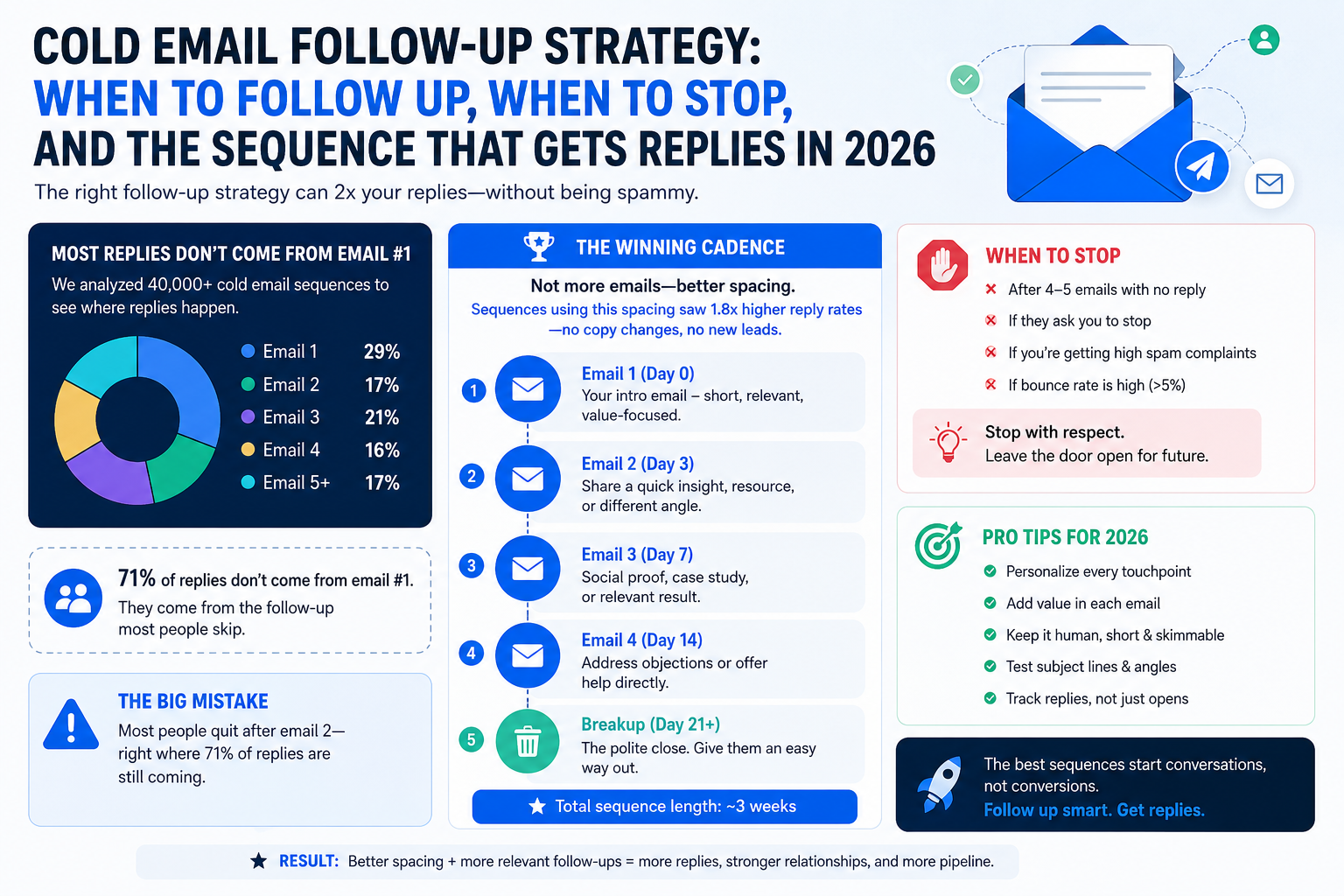
Cold Email Follow-Up Strategy That Gets Replies in 2026
Most SDRs treat follow-ups as free real estate — the more the better. They're wrong. Every step in your sequence costs you domain reputation, mailbox volume, and goodwill with the people you're trying to reach. Here's how to build a follow-up strategy that drives replies without quietly torching your deliverability.
Why Most Follow-Up Sequences Quietly Destroy Deliverability
Follow-ups aren't free sends. Every email in your sequence counts toward your mailbox's daily sending limit — and those limits are tighter than most people assume. The recommended ceiling is 50–100 emails per mailbox per day. If you're running a 3-step sequence to 300 prospects, you're not sending 300 emails. You're sending 900. That math compounds fast when you're managing multiple campaigns across multiple mailboxes.
The deeper problem is what happens when your follow-ups generate the wrong signals. A sequence loaded with "just checking in" bumps gets ignored, deleted, and eventually reported. Each spam complaint chips away at your mailbox reputation. Each ignored send teaches Gmail and Outlook that your emails aren't worth surfacing. Reply rates between 2–5% are typical for cold outreach — sequences that push past three or four touches without a genuine value add tend to trend toward the lower end of that range and bring complaints up.
The goal of a follow-up isn't maximum touchpoints. It's maximum positive engagement per email sent. A prospect who replies — even to say no — is doing more for your sender reputation than ten prospects who silently ignored you.
The 3-Touch Sequence Structure SDRs Should Use
Three emails is the sweet spot for most B2B SaaS audiences. It's enough to give a genuine signal time to land, and short enough to avoid the complaint risk that builds with longer cadences.
Email 1 — Personalized cold open. Lead with a specific, relevant business observation: a hiring signal, a product launch, a funding round. One CTA. Keep it under 100 words. The goal is to make the prospect feel like this email was written for them, not fired at a list.
Email 2 — Day 3–5, new angle. Don't reference your first email. Bring something different — a proof point, a short case study angle, a specific pain point framed from a different direction. "[Unverified] Reply rate data comparing 2-touch vs 3-touch sequences for B2B SaaS specifically" isn't available, but directionally, adding a second angle rather than a reminder consistently outperforms "just following up" in reply quality.
Email 3 — Day 8–12, break-up frame. Short. Direct. Give them an easy out. Something like: "If this isn't relevant right now, no worries — I'll stop reaching out." This format works because it reduces friction. Prospects who were on the fence will often reply to close the loop, and that reply is still a positive engagement signal for your domain.
Timing Between Follow-Ups: The Numbers That Actually Matter
The window between your first email and your first follow-up matters more than most SDRs think. Sending the follow-up within 24 hours looks automated and spikes complaint risk. Waiting more than 14 days bleeds momentum and makes the second email feel cold again. The practical window is Day 3 to Day 5 for your first follow-up, and Day 8 to Day 12 for your third touch.
Timing also means time of day, not just spacing. If your prospect list spans multiple time zones, a follow-up sent at 9 AM your time might land at 2 AM theirs. Timezone-based sending ensures every follow-up arrives during local business hours — which directly affects whether it gets seen before 40 other emails pile on top of it.
Two other settings that matter more than people expect:
- Random delays between sends (3–7 minutes): Identical send intervals look automated to spam filters. Randomizing the gap between emails in a batch creates a more natural sending pattern.
- Business-hour windows: Restricting sends to roughly 8 AM–6 PM local time keeps your emails arriving when recipients are actually working.
Neither of these changes will save a bad sequence, but both reduce unnecessary friction with spam filters.
When to Stop: Hard Rules for Cutting Prospects From Your Sequence
Knowing when to stop is as important as knowing when to follow up. There are a few non-negotiable rules:
| Trigger | Action |
|---|---|
| Negative reply ("not interested," "remove me") | Stop immediately. No more emails in the sequence. |
| Hard bounce on Email 1 | Remove before Email 2 is sent. Never follow up on a bounce. |
| 3 touches, no reply | Pause. Wait 60+ days before any re-engagement attempt. |
| Sequence spam complaint rate above 0.1% | Trim the cadence or pause the campaign to investigate. |
Continuing to email a prospect after a "not interested" reply isn't just rude — it's a complaint waiting to happen. One complaint from a small campaign does more damage than it looks like on paper. Spam complaint benchmarks make this clear: keep your rate below 0.1% to stay in good standing with mailbox providers. Above 0.3% and you're looking at real deliverability problems.
Hard bounces deserve the same urgency. A hard bounce means the address doesn't exist or the mailbox is gone. Following up anyway generates another bounce, signals poor list hygiene, and compounds reputation damage with each attempt.
Write Follow-Up #2 Like a Human, Not a CRM Reminder
"Just following up on my last email" is the single most common line in cold email follow-ups. It also signals automation immediately, adds zero value, and trains prospects to ignore the sender. Drop it entirely.
Follow-up #2 should stand alone. If a prospect never saw your first email, this one should make sense on its own. Reference something new — a recent company announcement, a relevant data point, a single-sentence case study that speaks to their specific situation. The bar is: would a thoughtful salesperson write this, or does it read like a sequence tool generated it at 3 AM?
Keep it under 75 words. Brevity isn't laziness here — it's a signal that you respect their time and you're confident in what you're offering. Long follow-ups often over-explain because the sender is nervous the first email didn't land. That energy comes through.
If you're using AI to draft follow-ups at scale — which is fine — build in an editing step. Strip phrases like "leverage," "unlock," and "cutting-edge." Fix generic openers. Verify any company facts the AI generated, because AI hallucinations in personalization destroy credibility fast.
Infrastructure Check Before You Scale Your Sequence
Before you load a 3-touch sequence onto 1,000 prospects, run the math. A 3-touch sequence to 1,000 people is 3,000 emails. If you're running that over two weeks across three mailboxes, each mailbox is carrying roughly 500 emails in that window. That's manageable — but only if your domains are warmed, your mailboxes are healthy, and your daily volume stays under 300 emails per domain.
The planning framework most teams skip: size your infrastructure around sequence depth, not just list size. If you're running a 4-step sequence to 5,000 prospects, that's 20,000 emails. Do the math on domains and mailboxes needed before you start, not after your reply rates drop.
Key infrastructure rules for sequences:
- Fully warm new mailboxes before assigning them to multi-step campaigns. A mailbox in week one of warmup shouldn't be handling follow-up volume.
- Keep domain daily volume under 300 emails to protect reputation across the full sequence duration.
- Plan for 5–8 domains (3 mailboxes each) for a medium campaign targeting 5,000–10,000 prospects with a multi-step sequence.
- Monitor per-mailbox send counts — follow-ups from multiple campaigns stacking on the same mailbox can push you over safe daily limits without you noticing.
XemailCampaign's warmup runs in the background while you build out your sequence, so you're not waiting on reputation to build before you can start planning campaigns.
Next Steps
Run this checklist before your next sequence goes live:
- Sequence is capped at 3 touches unless you have data showing your audience responds to more
- Email 2 introduces a new angle — no "just following up" language
- Follow-ups are scheduled with 3–5 day gaps, not same-day or next-day
- Timezone-based sending is enabled so follow-ups land during business hours
- Hard bounce suppression is active — no follow-ups sent to bounced addresses
- Stop logic is configured for negative replies
- Daily domain volume stays under 300 emails across all sequence steps
- All sending mailboxes completed a full warmup before the campaign launched
- Spam complaint rate is being monitored per sequence, with a 0.1% threshold as your alert trigger