Cold Email Domain Rotation: When It Helps vs. Hurts
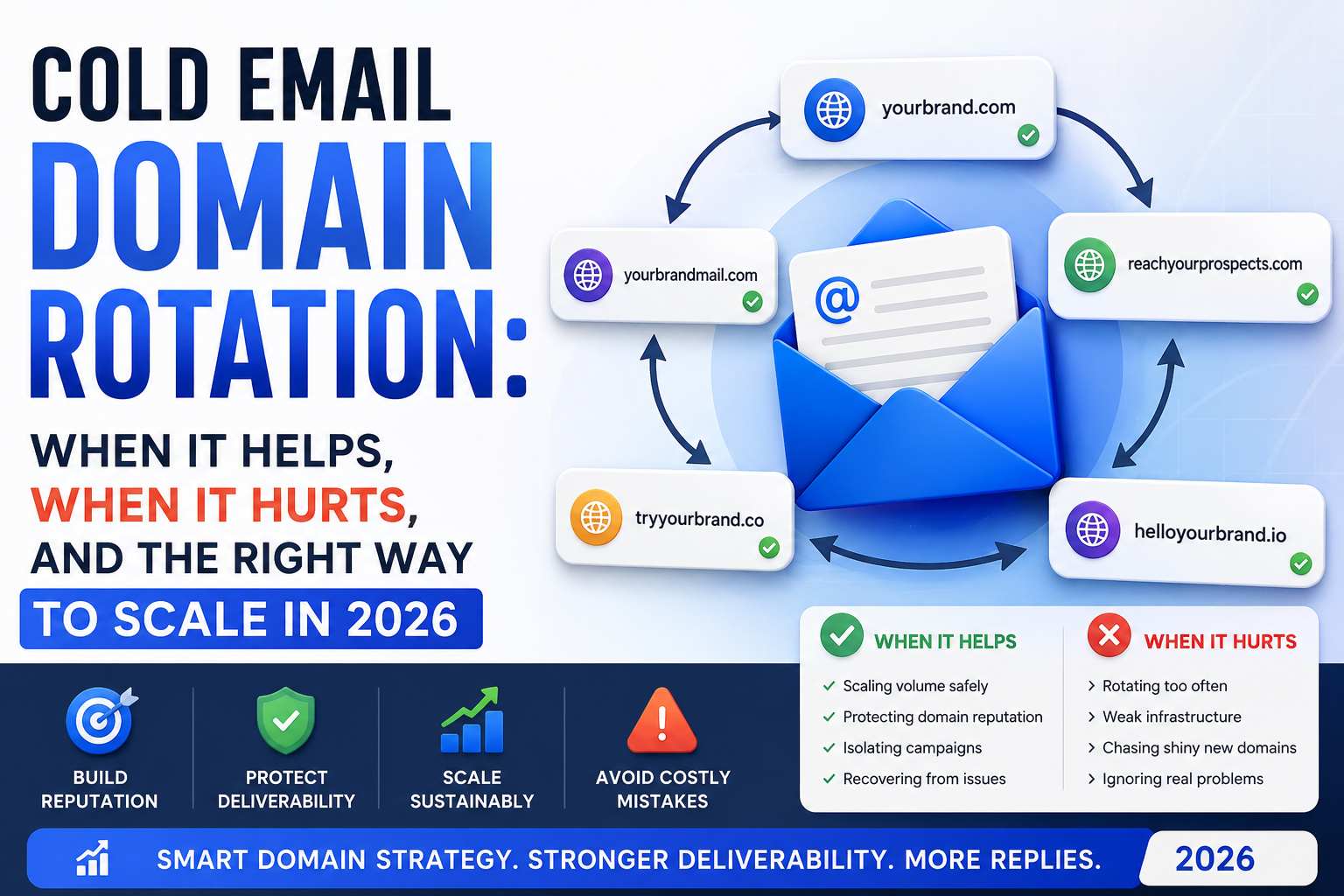
Cold Email Domain Rotation: When It Helps vs. Hurts
Domain rotation sounds like a deliverability silver bullet — swap in a fresh domain and watch your reply rates climb. It doesn't work that way. Done right, rotation protects your sender reputation and lets you scale safely. Done wrong, it buys you two weeks before you're back in spam.
What Domain Rotation Actually Means (And What It Doesn't Fix)
Domain rotation means spreading your cold email sends across multiple secondary domains instead of pushing all volume through one. You're not swapping domains mid-campaign or cycling through addresses every few days — you're building a pool of sending infrastructure where each domain handles a defined slice of your outreach.
The key thing rotation doesn't do: erase bad sending behavior. If you're generating high bounce rates or spam complaints, those habits follow you to every new domain you spin up. Rotation distributes reputation risk across multiple assets. It doesn't reset your reputation or compensate for poor list hygiene.
Secondary domains exist specifically to isolate your root domain from the volatility of cold outreach. Your company.com handles customer emails, contracts, and internal comms. Your companyhq.com or getcompany.com takes the reputation risk of prospecting. Rotation extends that logic — instead of one secondary domain absorbing all the risk, you spread it across several.
When Domain Rotation Genuinely Helps Your Deliverability
The clearest case for rotation is volume. A single properly warmed domain with three mailboxes can handle roughly 300 emails per day at 100 emails per mailbox. If you're targeting 5,000+ prospects with a multi-step sequence, one domain creates a bottleneck — and tempts you to push past safe limits.
Segmenting by ICP across separate domains is one of the smartest rotation strategies available. Founders and CFOs behave differently as email recipients. Engagement rates differ. Complaint rates differ. When you mix them on one domain, you can't tell which audience is hurting your reputation. Separate domains give you clean, independent reputation signals per audience.
Rotation also provides a blast shield. If a campaign targeting a cold list underperforms — higher bounces, more spam reports — it stays contained. It can't drag down a well-performing domain targeting a warm, tightly qualified list. And when you're testing messaging variants, separate domains mean your A/B test results don't contaminate each other's reputation data.
| Situation | Rotation Helps? |
|---|---|
| Scaling past 300 emails/day | Yes |
| Targeting 2+ distinct ICPs | Yes |
| Testing new messaging angles | Yes |
| One campaign underperforming | Depends — diagnose first |
| Trying to escape low reply rates | No |
When Rotation Hurts: 3 Mistakes SDRs Make
Rotating to a fresh domain before diagnosing the old one. This is the most common and most damaging mistake. A domain struggles, so you abandon it and spin up a new one — carrying the same broken list, the same off-target messaging, the same aggressive volume. Within weeks, the new domain is in the same place. The problem was never the domain.
Treating domains as disposable and skipping warmup. Every new domain starts with zero reputation. Providers treat aggressive early sends as a spam signal. If you're adding a domain and immediately routing production traffic through it, you're not rotating — you're just generating a new batch of deliverability problems. Warmup is not optional.
Mixing multiple campaigns on one domain to cut costs. This makes troubleshooting nearly impossible. When inbox placement drops, you have no way to identify which campaign or audience caused the decline. One domain per campaign is the standard for a reason: clean attribution, isolated reputation, faster diagnosis.
The Right Domain-to-Volume Ratio Before You Rotate
The math here is straightforward. Three mailboxes per domain, 100 emails per mailbox per day, gives you a ceiling of 300 emails per domain per day. That's a widely used benchmark for properly warmed infrastructure running at full capacity.
For a campaign targeting 10,000 prospects with a 4-step sequence, you're looking at 40,000 total emails. At 300 emails per domain per day, you need enough domains to spread that load without pushing any single domain past its safe limit. Budget 5–8 domains minimum for a campaign that size. The conservative end of that range gives you room to absorb a domain having a bad week without stalling the entire campaign.
The most important timing rule: add domains before you hit capacity, not after deliverability degrades. Once a domain is under reputation stress, you're already behind. Plan your infrastructure for the volume you're heading toward, not the volume you're at today.
- Conservative build: 5 domains × 3 mailboxes × 75 emails/day = 1,125 emails/day
- Standard build: 7 domains × 3 mailboxes × 100 emails/day = 2,100 emails/day
- Large campaign: 10+ domains, segmented by ICP or campaign objective
Warmup Is Non-Negotiable Every Time You Add a Domain
A new domain has no history with mailbox providers. No complaints on record, no engagement signals — but also no trust. When a brand-new domain starts sending 200 emails on day one, providers have one familiar reference point for that behavior: spam operations.
Minimum warmup before production sends is 30 days. If you're planning to push toward the higher end of volume (80–100 emails per mailbox per day), 45 days is the safer threshold. The warmup period builds the reputation baseline that makes scaling possible. Skip it and you're borrowing against reputation you don't have.
XemailCampaign's built-in warmup runs in the background while you focus on copy and sequencing — you don't have to manually manage a warmup calendar on top of everything else. But warmup isn't just a checkbox to clear once. If you migrate mailboxes to a new domain, restart warmup. Reputation doesn't transfer between domains. A mailbox that earned trust on companyhq.com starts from zero on companyreach.com.
How to Know It's Time to Rotate — Not Just Optimize
Low reply rates and dropping opens don't automatically mean you need a new domain. Most deliverability problems are recoverable: fix authentication, clean the list, improve targeting, reduce volume. Rotation should be a last resort, not a first response.
The signals that point to genuine domain-level damage are more specific. Persistent spam folder placement after you've already fixed your SPF, DKIM, and DMARC — and verified list quality and content — suggests the domain itself has accumulated too much negative reputation to recover on its normal timeline. Repeated blacklist listings that return shortly after removal are another clear sign. When every mailbox on a domain underperforms while the rest of your infrastructure looks healthy, the domain is the common factor.
The correct sequence is pause, diagnose, then rotate. Pull back sending volume, investigate authentication, check reputation monitoring tools, look at bounce and complaint trends. If you've gone through that process and the domain isn't recovering after a reasonable window, then rotating makes sense. If you skip the diagnosis and rotate immediately, you're just resetting the clock on the same underlying problem.
Next Steps
- Confirm you have one domain per campaign — not multiple campaigns sharing infrastructure
- Check your current domain-to-volume ratio against the 300 emails/domain/day ceiling
- Map your ICPs and determine if different audiences warrant separate sending domains
- Verify warmup is active on every domain before production sends begin
- Set up reputation monitoring so you catch warning signs before they compound
- Before rotating a struggling domain, run through: authentication, list quality, content, and volume — in that order